> ## Documentation Index
> Fetch the complete documentation index at: https://docs.rootprint.io/llms.txt
> Use this file to discover all available pages before exploring further.
# Traces
> How Rootprint stores OTLP spans, how a trace is reached from a log, and what trace support does and does not cover in this release.
Rootprint ingests OpenTelemetry spans over OTLP and pairs them with your logs. A log carrying a trace ID opens the trace it belongs to, and every span in that trace links back to the logs it produced.
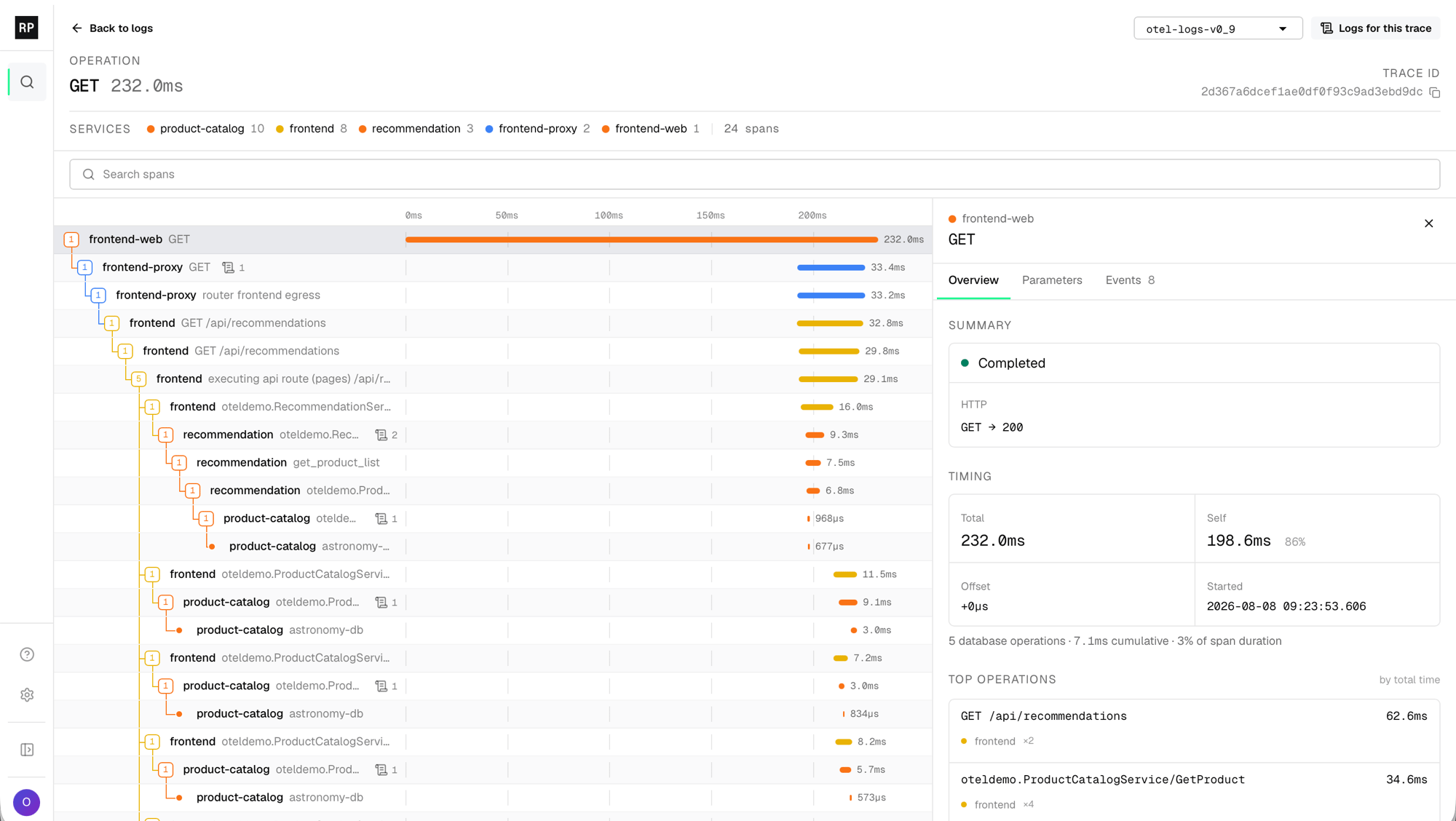 A trace opens as a waterfall. Spans are colored by service, the header carries the root operation and total duration, and selecting a span opens its details beside the waterfall. **Logs for this trace** jumps to the logs those spans produced.
## The span store
Every span goes into **one** Quickwit index, the span store, named by the `TRACE_INDEX_ID` environment variable. It defaults to `otel-traces-v0_9`.
Spans always land there regardless of which index the ingest key was created against. There is no per-key span destination.
The span store is not readable as a log index. The log explorer, histogram, field-values, and export endpoints all reject it with `404`.
## How you reach a trace
There are exactly two ways in:
* **From a log.** Open a log in the detail drawer and switch to the **Trace** tab.
* **By trace ID.** Paste a trace ID — 32 hexadecimal characters — into the log search box.
## Trace retention and time ranges
Opening a trace runs a raw `trace_id` search with **no time bound**, so a trace stays openable for as long as its spans are retained. The search window you had applied to your logs does not limit it.
## Limits
| Limit | Behavior |
| -------------------------- | ----------------------------------------------------------------------------------------------------------------------------------------------- |
| 2,000 spans per trace | Past the cap, the response sets `truncated` and the trace view says so. The spans you get are an arbitrary subset, not the first 2,000 by time. |
| Duplicate spans | OTLP retries produce duplicate span documents. Rootprint collapses them by `span_id`. |
| No per-index authorization | Any user or query API key with `logs: read` can read any trace by ID. |
**Trace IDs are not authorization.** The trace endpoint is not nested under an index, so there is
no per-index gate on it. This matches log search, where the same holds for any index a key can
reach.
## Requirements
* Quickwit `0.9.0` or later. See [Environment variables](/configuration/environment-variables).
* An ingest API key. Any existing key works — you do not create a separate one for spans.
## Next steps
Point an OpenTelemetry SDK or Collector at the trace endpoint.
The waterfall, span details, and correlating spans with logs.
A trace opens as a waterfall. Spans are colored by service, the header carries the root operation and total duration, and selecting a span opens its details beside the waterfall. **Logs for this trace** jumps to the logs those spans produced.
## The span store
Every span goes into **one** Quickwit index, the span store, named by the `TRACE_INDEX_ID` environment variable. It defaults to `otel-traces-v0_9`.
Spans always land there regardless of which index the ingest key was created against. There is no per-key span destination.
The span store is not readable as a log index. The log explorer, histogram, field-values, and export endpoints all reject it with `404`.
## How you reach a trace
There are exactly two ways in:
* **From a log.** Open a log in the detail drawer and switch to the **Trace** tab.
* **By trace ID.** Paste a trace ID — 32 hexadecimal characters — into the log search box.
## Trace retention and time ranges
Opening a trace runs a raw `trace_id` search with **no time bound**, so a trace stays openable for as long as its spans are retained. The search window you had applied to your logs does not limit it.
## Limits
| Limit | Behavior |
| -------------------------- | ----------------------------------------------------------------------------------------------------------------------------------------------- |
| 2,000 spans per trace | Past the cap, the response sets `truncated` and the trace view says so. The spans you get are an arbitrary subset, not the first 2,000 by time. |
| Duplicate spans | OTLP retries produce duplicate span documents. Rootprint collapses them by `span_id`. |
| No per-index authorization | Any user or query API key with `logs: read` can read any trace by ID. |
**Trace IDs are not authorization.** The trace endpoint is not nested under an index, so there is
no per-index gate on it. This matches log search, where the same holds for any index a key can
reach.
## Requirements
* Quickwit `0.9.0` or later. See [Environment variables](/configuration/environment-variables).
* An ingest API key. Any existing key works — you do not create a separate one for spans.
## Next steps
Point an OpenTelemetry SDK or Collector at the trace endpoint.
The waterfall, span details, and correlating spans with logs.